Object:
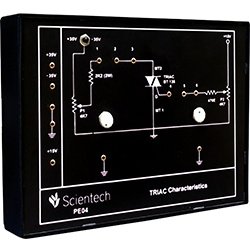
1. To study the gate characteristics of a TRIAC in the following modes :
(a) Mode I+ : i.e. T2 positive with respect to T1 and gate positive with respect to T 1
(b) Mode I- : i.e. T2 positive with respect to T1 and gate negative with respect to T 1
(c) Mode III+ : i.e.T2 negative with respect to T1 and gate positive with respect to T 1
(d) Mode III- : i.e. T2 negative with respect to T1 and gate negative with respect to T 1
2. To study the terminal characteristics of a TRIAC in the following modes :
(a) Mode I+ : i.e. T2 positive with respect to T1 and gate positive with respect to T 1
(b) Mode III+ : i.e. T2 negative with respect to T1 and gate positive with respect to T 1
3. To study the following applications of TRIAC :
(a) Triac as a static switch (D.C. control).
(b) Control of A.C. with A.C. signal.
(c) To measure the holding current of IH. Triac.
FEATURES
The board consists of following built-in parts:
01. 0-70V D.C. at 100mA, regulated Power Supply.
02. 0-3V D.C. at 30 mA, regulated Power Supply.
03. 55 Volt at 100mA, fixed A.C. Supply.
04. 7 Volt at 30mA, fixed A.C. Supply.
05. D.C Ammeter, 65mm rectangular dial with switch selectable ranges of 10mA and 100mA.
06. D.C Ammeter, 65mm rectangular dial to read of 0-30mA.
07. D.C. Voltmeter, 65mm rectangular dial with switch selectable ranges of 5V and 100V.
08. TRIAC.
09. Three Potentiometers.
10. Reset switch.
11. Adequate no. of other electronic components.
12. Mains ON/OFF switch, Fuse and Jewel light.