Atomization Pilot
Teaching Objectives of Atomization Pilot
- To manufacture a powder from a liquid solution
- Influence of the experimental conditions
- Determination of the energetic balance
- Mollier diagram analysis
Technical Specifications of Atomization Pilot
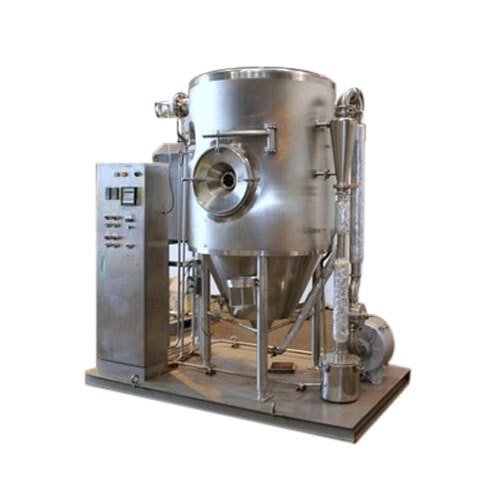
- Atomization chamber. Cover closing device. Insulation of the cover and the cylindrical part.
- A door for maintenance operations of the nozzle and cleaning operations, with lighted windows. A security device prevent the equipment running when the door is open.
- Bi injection fluid nozzle (air and liquid solution)
- Solution feeding pressurized vat, in stainless steel 316L. Function with compressed air
- Resistances heater with input air temperature process control
- 1 fan
- 1 Separation cyclone
- 3 Pt 100 O temperature probes, 1 at the atomizer input, 1 at the cyclone output, 1 for the measurement of the atomization chamber temperature.
- 2 humidity probes, 1 at the atomizer input, 1 at the cyclone output, of which one resist to 100°C.
- One over-pressure safety device consisting in a probe measuring pressure 0,5 bar switching off the compressed air feeding.
- The atomization tower is mounted on adjustable feet and is equipped with a platform with castors.
- Food processing construction
- Electrical cabinet including :
- The control and fan protection (with speed driver and potentiometer in option)
- The control and protection of electrical heater resistances, with the 2 static power units
- The regulator
- 6 displays (2 for humidity, 3 for temperature, 1 for air flow in option), emergency stop, switch with lock, switch on light
Optional Equipment :
- 1 anemometer probe for air flow measurement at the input of the heater
- 1 speed driver and 1 potentiometer to set the speed of the fan
Products Specifications:
The Atomization Pilot enables the treatment of following food liquids : milk, coffee, soup.
- Feed flow : 5 kg/h
- Dry material rate : 30 %
- Input temperature : 20°C
- Evaporation capacity : 3,5 kg/h
- Convert powder flow : 1.5 Kg/h
- Input air temperature : 180°C
- Output air temperature : 80°C
- Room temperature : 20°C
- Ambient humidity : 35 to 40%
- Outlet humidity : 3%
- Powder average temp : 50°C to 65°C
Dimensions
Essential requirements
- Compressed air : Reference pressure : 3 bars product / 2 bars compressed air
- Air consumption : 0 to 5 Nm3/h at 3 bars
- Power consumption : 24 kW – 50 Hz – 3 Phases + Gr + N
Atomization Pilot Manufacturers
Atomization pilot manufacturers producing a small quantity of product using an atomization process, typically for the purpose of testing and evaluating the product’s performance, quality, and manufacturability. Atomization is a method of producing fine droplets of a liquid or solid material, usually by using high-pressure air or gas to break the material into tiny droplets.
In atomization pilot manufacturing, the goal is to produce a limited quantity of product that can be used for testing and evaluation, before ramping up to full-scale production. This process typically involves the use of a pilot-scale atomization system, which is a smaller, laboratory-scale version of the equipment that would be used in full-scale production.
The output of the atomization pilot manufacturing process is typically used for a variety of purposes, including:
- Product performance testing: to evaluate the product’s properties and performance under various conditions
- Quality control: to assess the product’s quality and consistency, and to identify any potential issues
- Process development and optimization: to refine the atomization process and optimize conditions for full-scale production
- Scale-up: to validate that the pilot-scale process can be successfully scaled up to full-scale production
Overall, atomization pilot manufacturing is an important step in the product development process, as it provides valuable information that can be used to improve the product and the production process, and to ensure that the product is of high quality and consistent. Contact educational lab equipment fore more details